

Different style, topic and language for my post today, bringing you into something that deeply fascinates me: the intersection between
economics & geopolitics.
In the great technological race of the 21st century, few battlegrounds are as fiercely contested as artificial intelligence. The United States may have invented the modern AI boom—its universities, venture capital, and Big Tech firms turning algorithms into empires—but China is catching up fast. The contest is not just about who builds smarter machines, but who defines the rules, ethics, and strategic advantage of intelligence itself.

Over the past five years, China’s AI industry has shifted from imitation to innovation. Once accused of copying Silicon Valley’s ideas, Beijing’s ecosystem is now producing original research, competitive models, and applications that match Western quality at lower cost. Companies like Baidu, Alibaba, and Tencent—China’s internet giants—have been joined by newer players such as SenseTime, iFlytek, and Zhipu AI, each backed by state incentives and abundant data. According to the latest reports, China now contributes roughly one-third of the world’s AI research papers, and nearly half of its patent filings.
This scientific momentum has clear geopolitical undertones. For Beijing, AI is not simply an economic tool—it is a strategic imperative. The government’s “New Generation AI Development Plan,” launched in 2017, set the goal of making China the world leader in AI by 2030. The plan channels billions of dollars into national labs, start-up incubators, and public-private partnerships. Cities like Shanghai, Shenzhen, and Beijing’s Haidian district have become experimental grounds for AI-driven governance, from traffic management to health monitoring and even judicial decision support.


In contrast, the United States relies less on state planning and more on the dynamism of the private sector. OpenAI, Anthropic, and Google DeepMind dominate the conversation, backed by global investor confidence and a culture of rapid, open innovation. Yet Washington’s growing concern over technological sovereignty has shifted the tone. Export controls on advanced semiconductors, restrictions on capital flows, and an emerging AI safety regulatory framework all signal a desire to slow China’s climb up the intelligence ladder.
But curbing China’s progress is no simple task. Despite U.S. sanctions limiting access to cutting-edge chips from Nvidia or AMD, Chinese engineers have made surprising advances in hardware design and model optimization. Huawei’s latest AI chip, the Ascend 910B, demonstrates how domestic production can bypass Western bottlenecks. Meanwhile, open-source AI communities in China are thriving, with models like Baichuan and Yi-1 showing performance on par with mid-tier Western systems such as Meta’s LLaMA.


Still, China faces structural challenges. Its AI ecosystem is deeply centralized—efficient for scaling but stifling for creativity. Censorship and political red lines limit the open experimentation that drives breakthroughs. Western researchers still dominate in fundamental science, and global trust in Chinese AI remains
fragile, constrained by fears over surveillance and state control.
The rivalry, then, is less a zero-sum game than a divergence of
philosophies. America’s AI revolution is driven by private ambition and global collaboration; China’s by national strategy and domestic scale. Each has its strengths—and each exposes the other’s weaknesses. As the world edges toward AI-defined geopolitics, the outcome will not only shape who leads in technology, but how intelligence itself is governed.
In the long run, the contest may produce not one winner, but two competing worlds of artificial intelligence—each reflecting the values of its creators. The West will build AI for individuals; China will build it for the state. The true competition is not for smarter machines, but for the
human futurethey will serve.
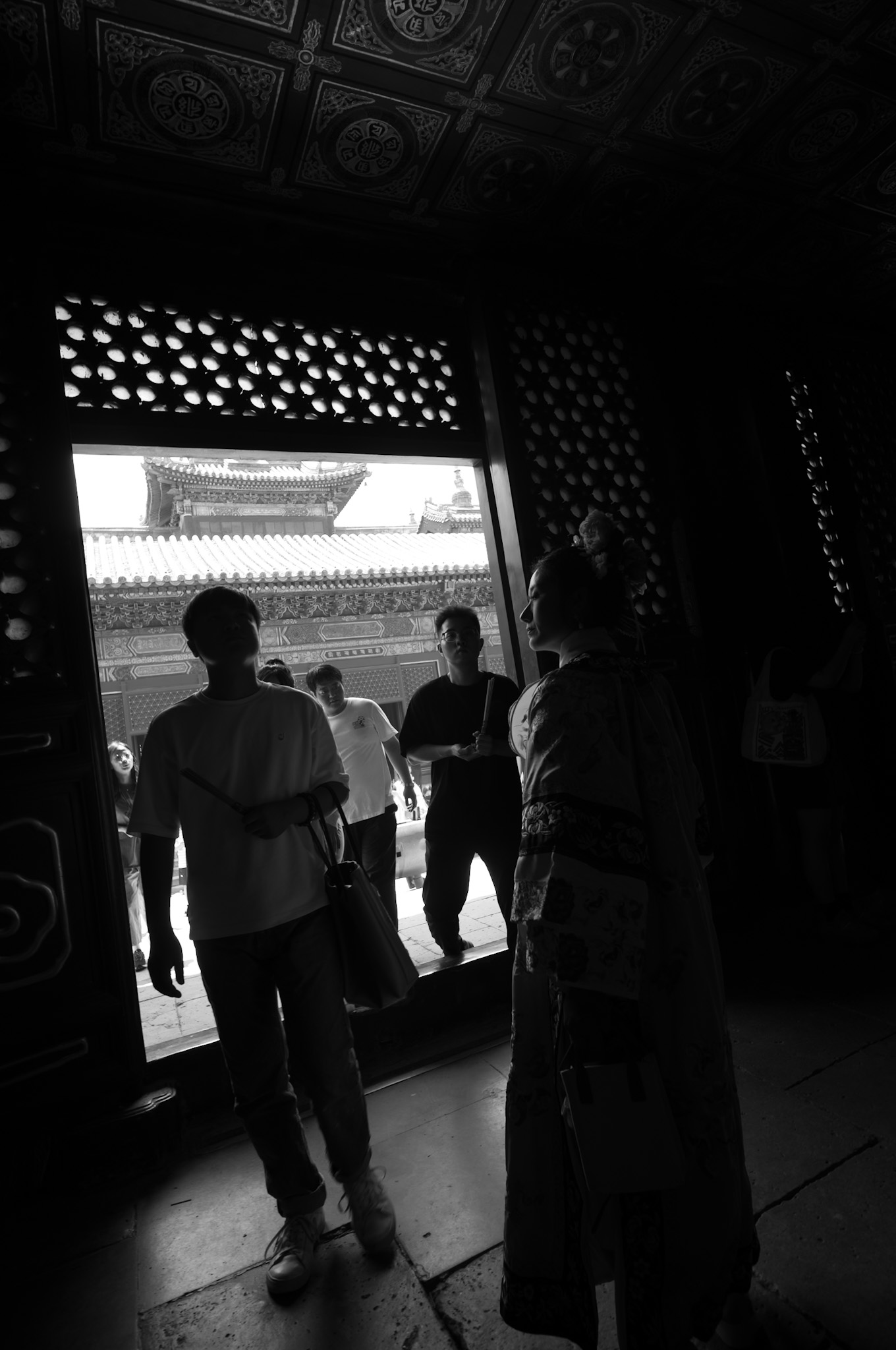
Photos from my trip to Beijing last year. Leica M11 Monochrom & Super Elmar 18mm